Showing posts with label 5th. Show all posts

Tuesday, January 31, 2012

CSI does CSI! 5th Grade


We had some interesting events take place at the CSI Lab last week. Last Sunday a group of scientists held a meeting at our science lab. On Monday morning, our principal, Mr. Ogg, received 5 phone calls from different women claiming they left a skull and some money in the lab. Mr. Ogg took information from each of the women and turned the investigation over to the 5th graders to complete in CSI class on Wednesdays.


So we went to work gathering evidence from the scene. We found small hairs, fibers, a spot of a substance that looked like blood, a shoe print, money, a note and the skull. We labeled these carefully and then tested the fibers we found from the scene.

GATHERING EVIDENCE


MAKING A SLIDE OF A FIBER SAMPLE

CHECKING UNDER THE MICROSCOPES

COMPARE FIBER SAMPLES TO SAMPLES FROM THE SCENE


We wrote our observations in our journal. Students examined the photographs and information from the "claimants" and compared the information to the discoveries we were making.
TWO OF THE CLAIMANTS


GATHERING AND COMPARING INFORMATION


It was interesting comparing the different fibers under the microscope. They all looked different. It was easy to match the crime scene fabrics with the cotton fibers although at first they looked like wool.

COTTON: ALSO THE CRIME SCENE SAMPLE

MORE COTTON

WOOL

POLYESTER

Tomorrow we will test Chromatography of the ink left on the note at the scene and we will test the hairs that were found. We have information on all the claimants' pens and pets.


My favorite part of the lesson was when the scientists noticed connections and clues between the claimants by reading and thinking on their own. Parker noticed that two of the women in the photographs were wearing the same cap! Then, a group of students noticed that the women all looked alike! Joanna noticed that one of the woman's name was "Pam Entologist" and she was a paleontologist and therefore could have had a skull at the meeting!
Great thinking!
If you have any information about the person owning the skull and missing money, please leave a comment below.

Wednesday, January 25, 2012

Creating Magazine Covers Using Technology

"Create a Magazine Cover" has been an assignment that has been around a while. Students used markers or colored pencils to enhance and extend ideas cut from real magazines.  It is exciting to re-design the lesson using technology and a website called Big Huge Labs. This idea came from Denise Burke, a Technology Specialist in Lewisville,  Texas. I tried the lesson out last year, with the 5th graders, after listening to her presentation at TCEA in Austin. Her presentation is repeated this year at TCEA and I highly recommend her session if anyone is planning to attend. Her presentation was entitled, "Exploring the Outer Limits: Web 2.0 Projects for GT Students". One of the highlights of her session was using "Big Huge Labs" to  create magazine covers.
Students use picsforlearning or edupics to select an image.

Example image selected by one of my students last year:
This one image will be cropped and edited through Picnik to make 3 different magazine covers for three different audiences. Picnik is free and easy to use. Students can save their cropped images to the desktop to make it easy to transfer to Big Huge Labs to create their covers.

Here is a magazine cover the student created using Big Huge Labs: I have them make a storyboard to organize their thoughts.


His audience was artists and craftsmen. He designed another cover by zooming in to the "black" area and targeting an audience interested in "oil and gas".


I love this project because ... the students are using the computer as a tool to create something new from their own thoughts. There are a million different ways to create their own magazine covers. It also promotes thinking specifically with  the student's ability to take on the perspective of another person: the audience of their created magazine. Tomorrow we are making our first magazine cover with this year's students. Mrs. Schoppe has made a rubric to help guide the students in creating an outstanding project. I will share the results in a post later.

Friday, January 20, 2012

Molds and Casts: 5th

I always liked making molds and casts using the Nasco Rubber molds of animal footprints. The molds are highly detailed and show the animal's unique characteristics.
Things to teach with this are almost endless:
molds and casts of fossils
fossil formation
what fossils teach us
animal tracks
animal adaptations (foot)
chemical reaction (plaster)

If I can connect art and science that is a plus, too. So when we paint the casts on day 2, we can be artistic.

Casts are dry in about two hours, so I was able to pop out the first class before the second class came. This gave everyone a good choice of molds to choose from.


We used eye loupes to examine my small fossil collection and made inferences about where they may have been found.


Day 2: Paint, Let Dry, and Take Home


Tuesday, December 13, 2011

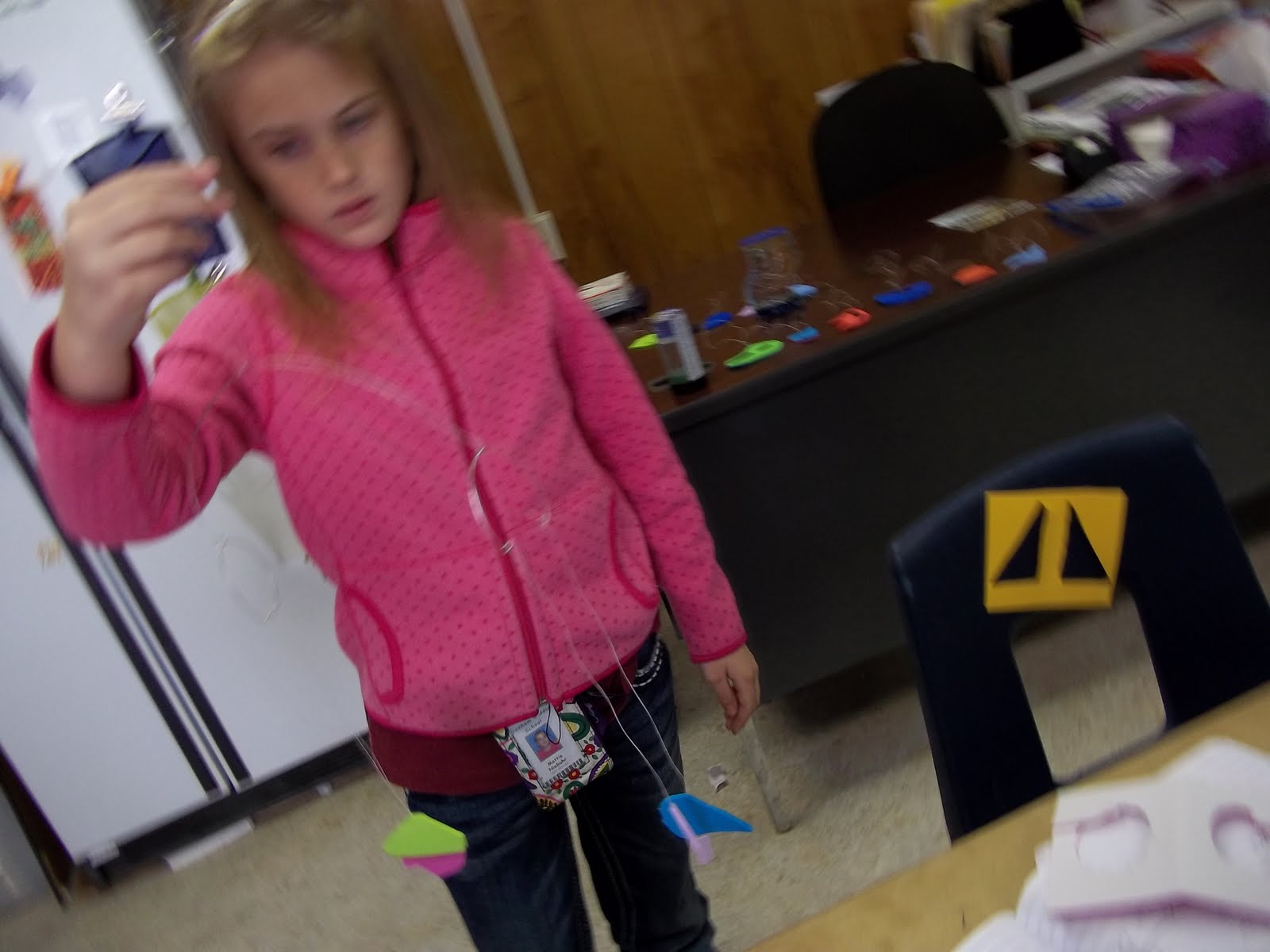
Alexander Calder: How Do Balance and Motion Connect Art and Science?


In this lesson, as we learned about the life of Alexander Calder, we connected art and science. We started out by reading "Sandy's Circus" by Tanya Lee Stone. The book is dedicated to "everyone brave enough to follow their own unique path in life." Alexander Calder was an artist, engineer and master of "motion" in his creations. He is the inventor of the "mobile" as well as the creator of many "stabiles" (enormous, bold metal sculptures which stand still). After reading the picture book, we watched the You Tube video from the Whitney Museum of Calder actually performing his circus in 1927.

CALDER ART


We first studied the three different types of levers. We used our journals to draw the different levers and label the "fulcrum", "effort" and "load". As we drew and labeled our drawings, it helped us identify the lever as either a first, second or third class lever.

I found an excellent resource for this at ArtsEdge website.

After studying the different levers and experimenting with a few examples, we were ready to build our Calder Mobiles and relate what we had learned to the newly created art.

The book, The Calder Game, by Blue Balliet, has a "Calder Secret Code" which we used to model our letters. Other Calder art examples were welcomed too but the students loved the Calder Secret Code.

I encourged the students to "balance" their mobiles which brought up the discussion of center of balance. We had worked a bit with center of balance earlier in the year.


Other Helpful Websites:

Art for Small Hands
Byrdseed Gifted Blog
Virtual Mobile
Salamander Art
Next year, we want to make the wire sculptures by Calder as well.

Friday, November 18, 2011

Unsolved Mystery 5th Grade Parent Day!

What a beautiful day we had for the parents to come by CSI to see the student's projects and how hard they had been working on creating their iMovies. Students could choose their own Unsolved Mystery like: Big Foot, Crop Circles, The disappearance of Amelia Earhart, even Black Holes to research and make their own iMovie. Thanks so much to Mrs. Schoppe who is always there to guide and help them as they create!
The lab was full of many science mysteries: One table had Magic Sand which showed the difference between "hydrophobic" and "hydrophilic" substances. Do you remember the difference?


Students got to make their own slime to take home. Green slime and the cross linking solution shows how polymers link together to form globby substances!


Pearl Swirl makes a Rheoscope which allows us to see currents within water. Pretty cool!


The giant Crystal Bubble made with Carbon Dioxide gas from dry ice melting is always a favorite!


Square bubbles were a challenge! Bouncing a bubble and playing catch with a bubble was more fun than challenging.


Before the parents came and before all the lab activities started, the students had a little time to work on their iMovies. While some were working, we used the Netbooks to make Wordles about our unsolved mysteries. We had some great Wordles. I hope to post them later.

Search

Mrs. Cook and Mrs. Kmiec

Mrs. Cook and Mrs. Kmiec
First Lego League Competition 2014

About US

Mrs. Sarah Cook and Mrs. Janis Kmiec are the lead investigators at CSI. Mrs. Cook manages the lab lessons as well as the Science Curriculum for BISD. Mrs. Kmiec leads the technology lab investigations. Both teachers love making CSI fun, exciting, and full of learning for their students.